To Whom It May Concern#q=okay It Was Over and I Wouldnt Make That Mistake Again
When to Utilise the Phrase "To Whom It May Business concern"
By Victor Johnson
July xiv, 2021
Victor Johnson is a career facilitator for Goodwill Columbus in Ohio with over 35 years of experience in training, instruction, career development and instructional design. Victor is an Air Strength veteran and is licensed by the land equally a Career Pathways Specialist.
Whether yous're writing an email or preparing a physical letter, it'due south of import to begin every business organization correspondence with an appropriate greeting. One of the most mutual professional salutations is, "To Whom It May Business organization." But with then many alternatives, information technology tin exist challenging to determine when it's appropriate to use this greeting and when you lot should employ a recipient'south name, championship or something else.
To help y'all compose a professional person correspondence, consider the following groundwork information on this greeting, tips for when to use it and alternatives you can choose instead.
Why people greet with "To Whom It May Business organisation"
Traditionally, the phrase "To Whom Information technology May Business concern" is used in business concern correspondences when you don't know the recipient's name or you're not writing to a specific person. For example, if you lot're writing a cover letter every bit role of a task awarding and information technology's not clear from the task posting who will be reviewing your application, you may cull to outset your letter with "To Whom It May Concern."
This greeting was adult when it was more hard to identify people's job roles by researching companies, online public directories or professional organizations.
Today, it's much easier to find the names of HR managers, department heads and other decision-makers you may exist attempting to attain. Equally a upshot, this greeting has come to be viewed as outdated and quondam-fashioned.
Notwithstanding, you should only include someone's proper noun if you're certain they'll be the 1 receiving your electronic mail or letter. Addressing your message to the wrong person could create confusion or await unprofessional. In those circumstances, it may exist better to use the phrase, "To Whom It May Concern" or an culling.
When to use the phrase "To Whom Information technology may Concern"
When do you apply "To Whom Information technology May Business?" Peradventure nosotros are looking at the concluding question to inquire. The outset question should be, "In formal correspondence, what is the advisable greeting to use?" Greeting a person by proper noun and/or job championship indicates several qualities of the sender:
It shows your respect
Greeting a person by name or championship shows that you recognize their humanity and/or their profession.
It shows your diligence and determination
There are times when sending a cover letter or other correspondence related to applying for a job, you may not know the name of the leaseholder. To observe the right person, task title or department would accept diligent inquiry online or by phone coupled with patience.
It shows you sympathize present-day order and recognize diversity
Forget the pitfall of thinking in terms of being "politically correct." It is a respectful courtesy to address someone in the manner they prefer. You may not know whether a person prefers to be addressed as she/her or them/they pronouns.
Starting with "Dear Sir or Madam" could be seen equally a lack of understanding of diverseness in today's workplace.
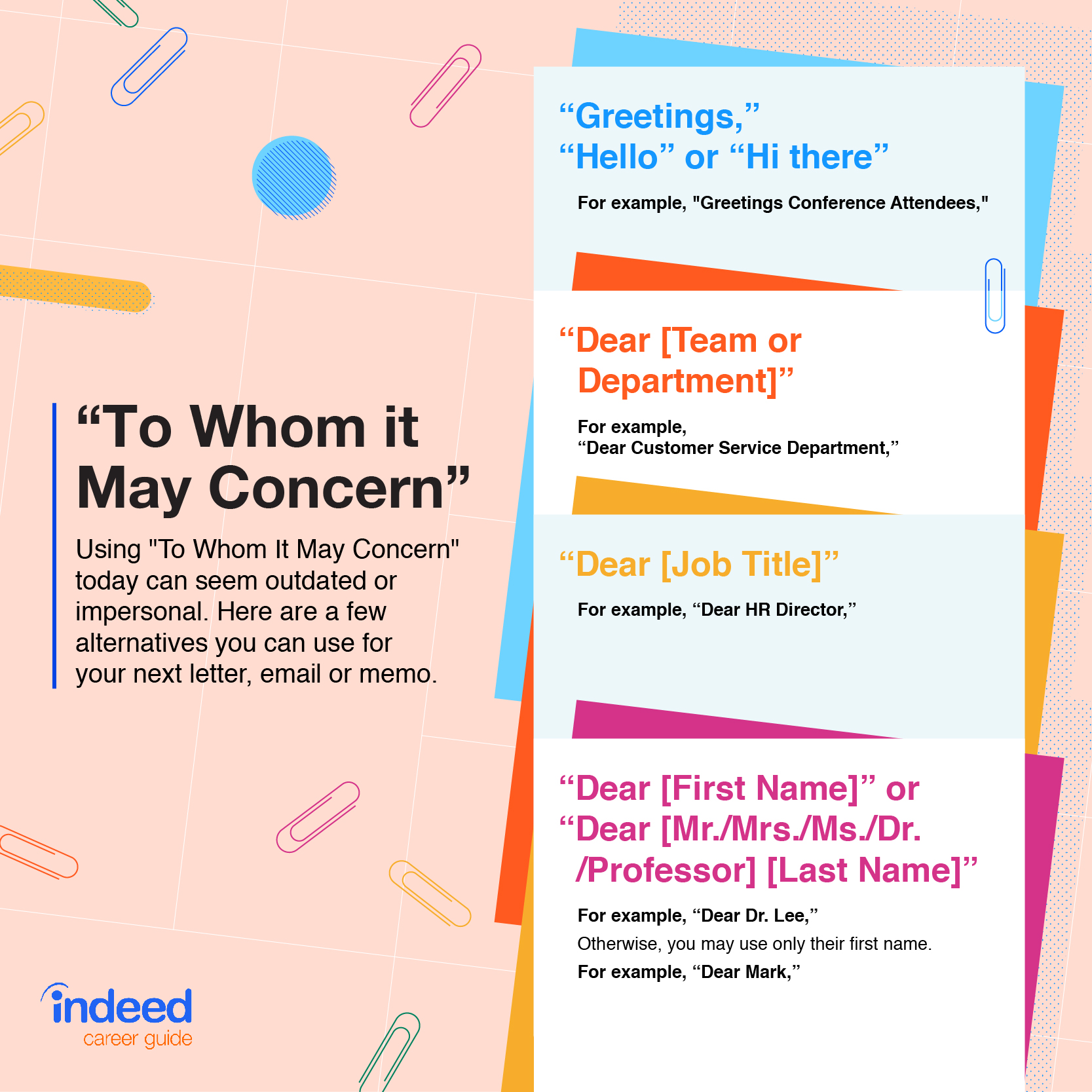
Image clarification
"To Whom It May Concern" Alternatives
"Greetings," "Hello," "Hullo there," "Dear [ Squad or Department ] ," "Dear [ Job Title ] ," "Dear [ Showtime Name ] ," or "Dear [ Mr./Mrs./Ms./Dr./Professor ] [ Last Proper noun ] "
Steps to take earlier using "To Whom Information technology May Concern"
Yous should consider researching for a indicate of contact earlier using "To Whom It May Concern." Using this salutation when the name of the contact is easily discoverable could leave a negative impression on the recipient equally it might convey that you did not take the time and effort. This is especially true when writing an email or cover alphabetic character in hopes of employment. Before using "To Whom It May Concern," y'all should consider taking these actions:
Check the job posting
If yous're sending an e-mail every bit part of a chore application process, be sure to carefully review the chore posting for a contact name. Sometimes employers include the name of the recruiter or hiring manager responsible for reviewing applications within their posting.
Use the company website
Effort looking for the 'Staff' or 'Encounter the Team' section on the company website. Wait for the manager of the department you're applying to or the caput of the human resources department.
Apply a professional networking website
Search for the recruiter or hiring manager for that section by seeing if the visitor has a professional folio on the networking website.
Enquire another contact
If you take a friend or acquaintance who works at the company, reach out to run across if they know the advisable person to address in the salutation.
Contact client service
When seeking a task, go the extra mile in the correspondence y'all send. If you tin't find the information y'all need on the net, use the clues you institute at that place. Ane inkling is a telephone number.
Call the company to inquire questions and find out where your correspondence should exist going. Inquire if they will disembalm the proper noun of the hiring director. Make sure to explain the reason you're seeking the information.
Instance: "Hello, my name is Jason Lopez and I'k applying for a position with your company's sales department. Would you heed providing me the name and championship of the hiring director so I can accost them appropriately?"
In larger companies, human resource representatives may exist prepare in different divisions. Even if y'all cannot locate the person, y'all tin can ask most the division and what the general job title is inside that department.
Instance: "To: Talent Acquisition Specialist, Crimson Widgets Division"
When to apply "To Whom Information technology May Business organization"
Here are five situations in which it'southward appropriate to utilize this salutation:
1. Embrace letter
When y'all're applying for a job, you may not know who volition be reviewing your resume, cover letter of the alphabet or application.
Employers often use a generic electronic mail alias for applications, such equally "recruiting@companyname.com" or "HR@companyname.com." In this case, it's unclear whether your application will be reviewed by a recruiter, HR leader, hiring director or multiple professionals.
Because yous must brand a positive first impression, it's better non to gamble incorrectly guessing the recipient's proper noun if you lot cannot find the point of contact through research.
2. Contact referral or recommendation alphabetic character
If a former colleague asks you to write a letter of recommendation or act equally a referral for a task opportunity, at that place's a good chance they may not know who will exist receiving the bulletin. In some cases, yous may also be required to submit your letter through an automated system that doesn't provide any names or titles.
If you lot do not have the contact's name or title, another greeting that you can utilize on a referral or recommendation letter is "To the Reader of This Alphabetic character." Although the deviation is slight, "To the Reader" seems more than direct than "To Whom It May Concern."
Read more: How To Write a Business Recommendation Letter of the alphabet
3. Introduction to a new or prospective client
If you are responding to an automated message from a potential customer and it doesn't include their proper name, y'all'll demand to utilise a more generic greeting. This is also an opportunity to ask their name and title so y'all tin be prepared to accost them direct in future communications.
Read more: How To Write a Business Introduction Letter (With Examples)
4. Prospecting letter
If you lot are in a sales or business evolution position, you may be responsible for contacting potential clients. Sometimes, company websites don't include the proper noun and contact information of the determination-maker yous're hoping to achieve. In this example, you may need to outset your alphabetic character with a generic salutation.
five. Company feedback or suggestions
If you want to share your feedback or suggestions with an employer, it's usually best to commencement by submitting your letter to HR.
Only if yous're not certain which person in the section is responsible for reviewing feedback, especially if it's a large system, it's acceptable to utilise a generic greeting. This is especially helpful if feedback will need to be addressed by multiple people or departments.
Related: 7 Types of Business Letters and When To Use Them
"To Whom It May Business" alternatives
In many cases, using this salutation can seem outdated, impersonal or unfriendly, especially if you've met the recipient or know their name or job role. Here are a few alternatives you may want to consider before starting a business email or letter with "To Whom It May Business organisation."
1. "Dear [ Commencement Name ] " or "Beloved [ Mr./Mrs./Ms./Dr./Professor ] [ Last Proper noun ] "
Be aware of your use of pronouns. If y'all have a get-go name, you can use it, just don't make guesses when you have a first and last proper noun but don't know the person.
For instance, Chris Cooper could exist she/her or he/him. If all yous have is the final name, apply the job title, "Honey HR Specialist Jones." It may seem a bit formal, notwithstanding, this correspondence may be your first opportunity to make a proficient impression.
If you lot know your recipient'due south name, you should use that instead of a more generic greeting. If you lot're contacting someone for the get-go fourth dimension, you may want to address them by title and surname.
Example: "Dearest Dr. Lee,"
Otherwise, you may utilise only their starting time name.
Example: "Beloved Mark,"
While at that place accept been surveys of HR professionals who say that "To Whom It May Concern" is non a deal-breaker, consider this: Somewhen, your cover alphabetic character or professional statement will be read by a homo existence.
ii. "Dear [ Task Title ] "
If you're non sure of the recipient's proper name just y'all know their task championship or role, you can use that instead.
Example: "Dear Hour Managing director,"
When writing a cover letter or alphabetic character of interest, here are additional alternatives to Hour Managing director:
-
"Love Hiring Director"
-
"Dear Hour Managing director"
-
"Beloved Recruiter"
-
"Dear Recruiting Director"
-
"Dear [ Department ] Manager"
3. "Dear [ Team or Department ] "
If you're addressing multiple people within a department or you're not sure which member of a team is the primary point of contact, yous may cull to include the section proper noun.
Example: "Dear Customer Service Department,"
4. "Greetings," "Hello" or "Hi there"
If you're sending a less formal correspondence, such equally an office memo or meeting announcement, you may choose to use a more than casual generic salutation. If applicative, you lot may also couple this with a team or section name.
Example: "Greetings marketing squad,"
When to capitalize "To Whom It May Concern"
The most common method is to utilize capital letters for the kickoff letter of every discussion, like this: "To Whom It May Concern,"
Think about this phrase as a replacement for someone's proper name. You would capitalize each first letter in a person's proper noun considering it is a name and it is polite and professional to use capitalization when addressing someone. You can use a comma or a colon subsequently the greeting. Insert a space between your greeting line and the first judgement of your alphabetic character.
Instance:
"To Whom It May Business concern:
My proper name is Joseph Hubbard and I am writing about your Lab Banana position …"
Related: How To Start a Business organization Letter (with Examples and Tips)
Using the proper salutation in business organization correspondences demonstrates stiff professionalism and communication skills. By knowing when to use "To Whom Information technology May Concern" and when to use alternative greetings, y'all'll make a positive impression in each email or letter you ship.
Related: 7 Elements To Include in a Concern Alphabetic character
withrowsisturionse.blogspot.com
Source: https://www.indeed.com/career-advice/career-development/when-to-use-to-whom-it-may-concern
0 Response to "To Whom It May Concern#q=okay It Was Over and I Wouldnt Make That Mistake Again"
Post a Comment